
Who’s Really in Prison for Marijuana?

prison bars
PHOTO COURTESY OF PBS.

One of the common assertions about marijuana is that many of the people in jail or prison for drug related offenses were convicted, and are serving lengthy sentences, for “simple possession” of marijuana. This classification refers to offenses involving small amounts of marijuana (enough to classify as only being intended for the owner’s personal use), generally carried by non-violent, first-time offenders. While it is true that a conviction for simple possession can entail at least jail time, if not prison time, judges most often give first-time offenders more lenient punishments, which can include fines and community service. Many first-time marijuana offenders may not even be arrested, let alone punished.

Additionally, most people who are sent to prison for marijuana possession are also sent for at least one other, more serious or violent, crime. It is misleading to claim that people are serving years (or life) long sentences for simple possession, when most, if not all, of those people are serving those sentences for possession while also serving sentences for much more severe crimes. State and federal sentencing guidelines generally do not encourage incarceration for the possession of personal-use amounts of marijuana, let alone do they encourage (or even allow) sentences of more than a few months for it. Reports on the federal and state prison systems routinely show that of all the people imprisoned for simple possession, almost all of them are serving those short sentences while also serving harsher sentences for harsher crimes, such as drug trafficking, participation in drug trafficking organizations or other organized crime, or other violent crimes.

Listed below are links to several of these reports.

https://www.ncjrs.gov/App/Publications/abstract.aspx?ID=204299

http://www.nadcp.org/sites/default/files/nadcp/Facts%20on%20Marijuana%20-%20NADCP_1.pdf

https://learnaboutsam.org/the-issues/marijuana-and-whos-in-prison/

Owning or Investing in a Marijuana Business

small business owner
PHOTO FROM HOPE FOR WOMEN MAGAZINE.

With the recent increase in legalization of recreational and medicinal marijuana use, many people have become interested in starting or investing in marijuana businesses. Something to keep in mind, though, is that people who are interested generally need to reside in the states in which the businesses are owned and operated. In Colorado and Oregon, for example, this means that if you would like to start or invest in a marijuana business, you need to have lived there for at least two years before applying for the appropriate business licenses. You may not invest in (let alone start) the business while living in another state or country. In Washington, investors only need to have been residents for three months, but their companies all have to be formed in state as well.

Another major point: no one may buy marijuana in a state where it is legal and take it to another state, even another state where it is legal. This constitutes drug trafficking, a federal offense, which law enforcement officials are on greater alert for due to the increasing number of states that allow legal marijuana use.

These links provide information on individual states’ policies regarding founding or investing in marijuana businesses.

http://www.bouldercountylaw.com/practice-areas/marijuana-business-licensing-faq#cannot-apply

http://www.greenrushconsulting.com/#!washington-legal-marijuana/c1vsw

http://www.northwestregisteredagent.com/growing-marijuana-legally-in-washington.html

http://www.oregon.gov/oha/mmj/pages/apply.aspx

Houston HIDTA Executive Board Meeting

NMI Presentation

This January, the Houston HIDTA Executive Board invited NMI National Coordinator Ed Shemelya to discuss the effects of legalized marijuana that have been observed in Colorado.  Texas law enforcement and public safety officials anticipate a battle over legalizing marijuana during the state’s upcoming 2017 legislative session, and the Houston HIDTA and its partners have made the proactive decision to start preparations early.  Mr. Shemelya’s presentation focused on the increased use of marijuana, especially among teenagers and college-aged adults.  Increased use has a number of side effects, which are harmful for individuals, but which can also pose a threat to broader public health, safety, and productivity, and people should accordingly be aware of these before deciding whether or not legalized marijuana is good for their communities.

Ed_Houston

Updates to Colorado Impact Report

impact report

The Rocky Mountain HIDTA has published an update to the third volume of their report on the effects of marijuana legalization in Colorado, focusing on the effects of legalization on youth and adult use.  Read the full report, as well as their previous reports, at the Rocky Mountain HIDTA website.

NMI and NETI Issues and Trends Meeting

Meeting Recap

In December, law enforcement personnel, including Appalachia HITDA Director Frank Rapier, gathered alongside policy makers, HIDTA personnel, and industry experts in Lexington, Kentucky to discuss issues surrounding anti-narcotics legislation. The meeting’s participants came from Kentucky, Tennessee, South Carolina, Georgia, Virginia, and West Virginia. The discussion was facilitated by Neely Carlton, a former Mississippi state senator. Ms. Carlton led the group in working through issues relating to the process of creating legislation, such as how to identify potential allies, and how to publicly state a group’s position in order to garner support among legislators.

The meeting took a different approach than many past narcotics officers’ conferences, examining opportunities for law enforcement to affect change through policy, rather than through direct enforcement initiatives. Discussions and training on these issues are critical, since topics like the best time to contact a legislator about creating a new law or the most effective ways to ask for support are not often thought of as necessary knowledge for those working in law enforcement. The meeting’s participants discussed their place within the legislative process, and where their ability to influence that process may lie. So far, the meeting’s organizers are receiving very positive feedback and hope to expand this approach for future conferences.

Changes in the Brain and Decreases in IQ

Marijuanas-Effects-on-the-Brain
PHOTO FROM RECOVERY.ORG.

There are conflicting studies about whether or not marijuana use can create physical changes in the brain or even lower people’s IQs.  But even if there are no physical changes to the brain, most agree that there are noticeable changes in the behavior of those who use marijuana.  Studies have found that those who began using marijuana during adolescence had lower IQs, and did not recover lost IQ points after discontinuing their marijuana use.  For those who did not start until adulthood, no IQ points were lost.

But this does not mean there are no side effects; other studies have shown that marijuana has negative effects on attention, memory, and learning, and that these negative effects can last for days or weeks after use. Understandably, these effects are also especially problematic for students as they negatively impact the processing and retention of knowledge.  In school, missing or not understanding even a few lessons can hurt a student’s overall performance since lessons are generally cumulative.

For those interested in reading about these effects in action, look at the links attached to the post on potential marijuana addiction.  There are two stories there of people who realized they were dependent on marijuana and the tolls it was taking on their lives.

Lung Diseases and Infections

Lung-Cancer-Awareness-Infographic
AN INFOGRAPHIC USED BY A HEALTHIER MICHIGAN AS PART OF LUNG CANCER AWARENESS MONTH.

Many people feel that because marijuana is a plant, that it is “all natural” and good for them. But marijuana can have similar health consequences to tobacco, especially among those who use it regularly. Frequent marijuana users have been found to suffer from chronic bronchitis, coughing on most days, excess phlegm production, shortness of breath, wheezing, and chest sounds without a cold, according to one US study. Marijuana plants can also have mold and fungi on them, as well as remnants of any chemicals used to grow them, and it is possible for users to ingest up to 70 percent of these while smoking, creating increased risks of infection and poisoning. Marijuana, like tobacco, also carries tar, which is associated with lung cancer, though this link has not been definitively proven for marijuana users. Because marijuana smokers keep smoke in their lungs longer than tobacco smokers, their lungs actually face greater exposure to tars, chemicals, and contaminants. In addition, smoking marijuana compromises the overall resistance of the lungs to disease, increasing rates of infection.  For a good summary of all the potential health hazards of marijuana, see this article from the National Institute of Drug Abuse.

Potential for Addiction

addiction photo
PHOTO FROM ADDICTIONRECOVERYUSA.COM

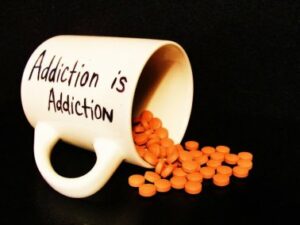
Though it is uncommon, it is possible for people to become addicted to marijuana. The National Institute on Drug Abuse estimates that between nine and ten percent of marijuana users will become addicted. For those who begin regularly using marijuana as adolescents, it is around 17 percent, and for those who use the drug everyday, it is between 25 and 50 percent. As mentioned in another post, average THC levels in marijuana have been on the rise in recent years, further contributing to an increased likelihood of addiction, especially for those who use concentrated forms of marijuana.

Many still contend that it is only possible to be psychologically, not physically, addicted to marijuana. Even if that’s true, in the long run it can be harmful to one’s mind, body, and life; even a psychological dependence involves changes in the brain. In a recent Vice article, the author gives her personal account of realizing she was addicted to marijuana and the negative impacts it had on her. Another article, an op-ed from the LA Times, gives the personal account of the impact that marijuana had on the writer’s life, and of what she understands now that she has removed it from her life. Both writers realized that there was more to life than what they had and that it was marijuana that was preventing them from attaining those things. Whether it was only psychologically or not, they both dependened on marijuana just to make it through the day, and eliminating it improved their lives. Without it, they were more productive, and focused more on the people and goals they had been neglecting.

For further reading on potential addiction to marijuana:

http://www.camh.ca/en/hospital/health_information/a_z_mental_health_and_addiction_information/marijuana/Pages/about_marijuana.aspx

http://www.theatlantic.com/health/archive/2014/09/is-marijuana-more-addictive-than-alcohol/380183/

Effects on Mental Illness

drugs and mental illness
A CHART ON MENTAL ILLNESS AND DRUG USE FROM SAHMSA.

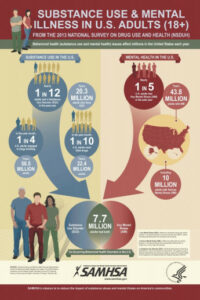
Some contend that marijuana has become a growing cause of mental illness. In truth, this has not been proven and it is clear that not all people who use marijuana will become mentally ill. There is evidence that supports the idea that marijuana use in adolescents is tied to an increased likelihood of developing depression or psychotic disorders, particularly schizophrenia and bipolar disorder. Use by those with congenital predispositions or certain genes is also tied to development of these disorders; marijuana can exacerbate the disorders’ symptoms and possibly bring them out sooner. Frequent marijuana use among teenagers is believed to be especially problematic because their brains are not yet fully developed; it is also linked to poor school performance. Whether marijuana use contributes to mental illness or not, recent studies have shown that marijuana use in those with mental illness can exacerbate the problem especially by derailing treatment efforts.

For more detailed reading:

http://www.ncbi.nlm.nih.gov/pmc/articles/PMC3221171/

http://www.camh.ca/en/hospital/about_camh/newsroom/news_releases_media_advisories_and_backgrounders/current_year/Pages/CAMH-study-shows-mental-illness-associated-with-heavy-cannabis-use-.aspx

Depression and Anxiety

anxiety:depression
PHOTO FROM LIFEWITHOUTDEPRESSION.ORG.

There has been a lot of discussion surrounding whether marijuana use contributes to or affects mental illness, particularly depression and anxiety. Most studies have shown that those who use marijuana, particularly beginning in adolescence, are more likely to suffer from depression and/or anxiety later on. Frequent use further raises this likelihood. Interestingly, those who suffer from depression and/or anxiety are not any more likely to use marijuana. Causality has not been definitively proven as to whether marijuana use causes depression and/or anxiety, but the relationship has been shown consistently.

Another related, possible consequence of marijuana use, especially for those who use marijuana often, is that it may damage the brain’s ability to process enjoyment. Studies have shown that people who use marijuana produce the same amount of dopamine (the brain chemical tied to pleasure and reward) as non-users, but that it does not create the same physical reaction for them that it does for non-users. And this lack of physical response indicates that marijuana users may have damaged the areas of their brains responsible for creating the feeling of enjoyment. Again, whether marijuana use causes the damage, or whether people use it to make up for existing damage, is unclear.